Emergency Guides · 5 min read
Ceiling Leaking During a Storm? What to Do in the Next 30 Minutes
A bulging ceiling is holding water and it can release all at once. Do not poke it from underneath. Here is the safe sequence.
Short answer
Move everything out from under the leak and switch off the circuit feeding that room at the breaker. Relieve a bulging ceiling from the side with a screwdriver so it drains in one controlled place instead of collapsing. Photograph the exterior before anyone tarps it, then get a tarp on and keep the invoice for your claim.
Wet drywall holds a surprising amount of water weight, and it does not let go gradually. A ceiling that is bulging is carrying a load, and when it fails it comes down in one piece.
The next thirty minutes are about safety first, then containment, then documentation. The permanent repair happens later and it happens better if you do these three things now.
Clear the Area and Kill the Circuit
Move everything out from under the affected ceiling, and keep people and pets out of the room. If the ceiling is visibly sagging, treat the area beneath it as a no-go zone rather than a place to put a bucket while standing there.
If there is a light fixture, ceiling fan or recessed can in the affected area, switch off that circuit at the breaker. Water travels along framing and exits at penetrations, which means fixtures are exactly where it tends to come through.
Relieve a Bulge — Carefully, From the Side
If the ceiling is bulging with trapped water, releasing it in a controlled way is better than waiting for it to fail. But do not stand under it and do not push a screwdriver up into the middle of the bulge.
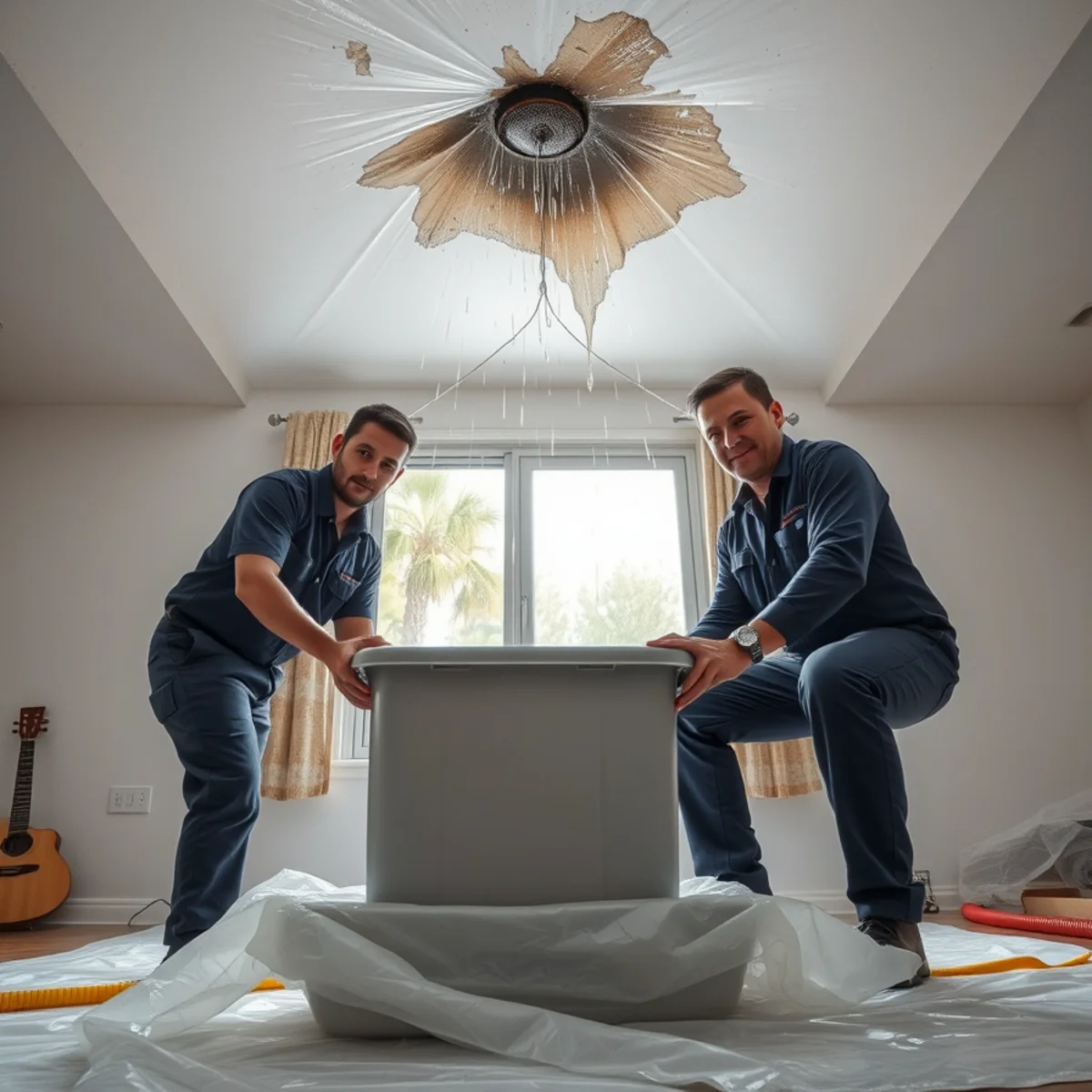
Position yourself to the side, put a large container or a tarp below, and make a small puncture at the low edge of the bulge using something with reach. Water will come out fast. Let it drain, then make a second small hole if needed.
If the bulge is large, if the ceiling has a heavy texture, or if you are at all uncertain, do not do this at all. Clear the room and wait. We relieve these regularly and it takes two minutes with the right position and the right equipment.
Standing water right now? Call us before you do anything else.
We are on site within 60 minutes anywhere in Irvine, 24 hours a day.
Photograph the Outside Before Anyone Tarps It
This is the step that decides your insurance outcome, and there is a narrow window for it.
Storm damage claims turn on a single question: did the storm damage the structure first, and then water came in through that opening? If wind lifted tiles and rain entered the gap, that is generally covered. If rain came through a roof that was simply worn out, carriers routinely deny it as deferred maintenance.
So before a tarp goes on, photograph the exterior damage — from the ground with a zoom or binoculars if the roof is not safe, from multiple angles, with the date. Note the storm date and, if you can, the wind direction. That package is what settles the argument later.
Get It Tarped, and Keep the Invoice
Emergency tarping is not optional in insurance terms. Most policies require you to take reasonable steps to prevent further damage, and delaying mitigation can reduce a payout even where the underlying claim is valid.
Reinforced poly, mechanically fastened over the breach, is what a proper tarp looks like. A blue tarp weighted with bricks is not, and it will be gone in the next wind event.
Keep the tarping invoice. Emergency mitigation is typically reimbursable even where the permanent repair is being disputed.
Understand That the Leak Is Not Above the Stain
Water entering a roof runs down the underside of the sheathing and along rafters until it reaches a low point, a seam or a fixture penetration, and exits there. Ten to fifteen feet of travel between the entry point and the visible drip is entirely normal.
That is why cutting the ceiling directly above the stain finds nothing useful, and why a competent assessment includes an attic inspection and thermal imaging rather than a guess.
It also means the attic above is wetter than the ceiling below. Saturated insulation does not dry in place, has already lost its R-value, and holds moisture against your ceiling joists. It comes out.
Do Not Just Paint Over It Afterwards
A stain-blocking primer will hide a water stain for a while. It will not fix anything, the stain will return because the source is still there, and painting over damp gypsum traps moisture against it — which is precisely the condition mold needs.
Source first, drying second, cosmetics last. Reversing that order is why so many ceiling repairs fail within a season.
One note specific to older Irvine and Orange County homes: if your ceiling has original popcorn texture from before roughly 1980, it must be tested for asbestos before anyone disturbs it. That is a legal requirement in California, not an upsell.
From the field
The leak is almost never directly above the stain
Water entering a roof lands on the sheathing or the top of a ceiling joist and then travels — along the slope, along a rafter, across the top plate of a wall — until it finds the first place it can drop through. In a tile roof with an intact-looking surface, that travel distance is routinely eight to fifteen feet. So a ceiling stain in the middle of a bedroom frequently traces back to a cracked field tile or a failed pipe boot near the ridge, nowhere near the room below.
This matters practically, because the most common failed repair we see is a roofer sealing whatever they found closest to the stain, followed by the same stain reappearing in the next storm. Finding the actual entry point means going into the attic during or right after rain with a light and following the wet track uphill to where it starts, or inspecting the penetrations and valleys upslope of that track.
Honest tradeoff on tarping: a tarp is emergency mitigation, not a repair, and most policies reimburse it as an emergency expense. But a tarp installed badly — nailed through a good field of tile, or laid without carrying over the ridge — creates new penetrations and channels water under the covering. If the storm has passed and a dry window is coming, a proper inspection first usually beats a rushed tarp.
Photograph the exterior before the tarp goes on
A tarp hides the storm damage that proves the loss was sudden. Get roof and elevation photos first, in daylight, if you can do it safely.
Do not just paint over the stain
Sealing over a stain traps moisture in the drywall and insulation above it. Dry the cavity to standard first, then prime with a stain-blocker, then paint.
Frequently Asked Questions
Should I put a hole in my bulging ceiling?
If you can do it from the side, with a container below, at the low edge of the bulge, and the bulge is small — yes, controlled release beats an uncontrolled collapse. If the bulge is large, the ceiling is heavily textured, or you are uncertain, clear the room and call someone. It takes us two minutes with the right position.
Why is my ceiling stain nowhere near the damaged part of the roof?
Water runs along framing and along the top of drywall sheets until it finds a seam, a fastener or a light fixture penetration, then drips there. Fifteen feet of travel is normal. This is why the assessment needs an attic inspection and thermal imaging rather than cutting above the stain.
Does homeowners insurance cover a roof leak?
It covers leaks caused by sudden storm damage — wind lifting tiles, a limb breaching the roof. It generally excludes leaks from a roof at end of life. Photograph the exterior damage before tarping, record the storm date, and report promptly. The photographs are what decide it.
Need help with this in Irvine?
We handle this work every week across Irvine and Orange County. A live dispatcher answers 24/7, gives you an arrival window, and tells you what to do while you wait. Free on-site assessment and written scope before any demolition.
Related services