Emergency Guides · 5 min read
Dishwasher Leaked Overnight and Flooded the Kitchen — Now What?
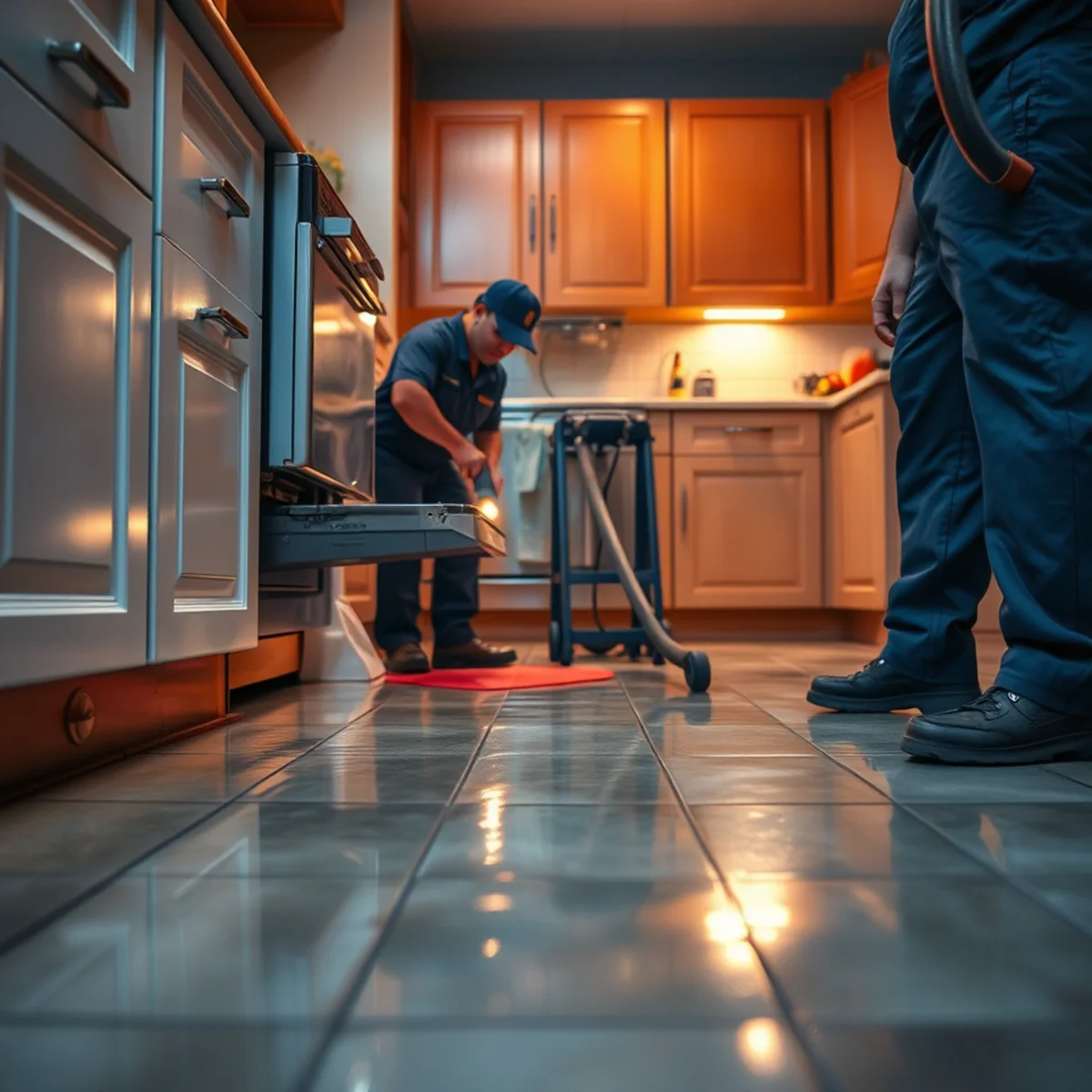
The puddle on the tile is not the problem. The water that went under the dishwasher, under the cabinet toe-kicks and under the flooring is.
Short answer
Stop the cycle and close the dishwasher's supply valve under the sink, then kill the kitchen circuit at the breaker. Do not pull the machine out — you will drag water further under the cabinets. Photograph everything, then call for extraction. The cabinet bases are where the real cost sits, not the visible floor.
Kitchen leaks are deceptive because the visible water is the smallest part of the story. A dishwasher sits in a recess under the counter with cabinets on both sides, and water that escapes there goes under the unit, under the adjacent cabinet bases, and under the flooring — all places you cannot see or reach.
That is why the cost of a kitchen leak has almost nothing to do with how big the puddle looked.
First: Stop It and Kill the Power
There is a shut-off for the dishwasher supply, usually under the adjacent sink — a small valve on the hot line with a tube running toward the dishwasher. Close it.
Then switch off the dishwasher circuit at the breaker. Many dishwashers are hardwired rather than plugged in, so unplugging is not an option, and an appliance sitting in water on a live circuit is a hazard.
Do not run the dishwasher again to see if it still leaks. That is how a contained problem becomes a second one.
Work Out Which Kind of Leak It Was
A supply-side failure — the water line feeding the machine — is clean water. Most materials can be saved with fast extraction and drying.
A drain-side failure, or water escaping mid-cycle with detergent and food waste in it, is Category 2 gray water. Porous materials that absorbed it are handled differently, and cabinet bases that soaked it up generally do not come back.
A door seal failure that has been weeping slowly for months is its own category. That water has been going under the flooring the whole time, and by the time you notice it there is frequently mold under the toe-kick.
Standing water right now? Call us before you do anything else.
We are on site within 60 minutes anywhere in Irvine, 24 hours a day.
The Cabinet Bases Are the Real Cost
Almost all kitchen cabinet boxes, even in expensive kitchens, are particleboard or MDF underneath the visible finish. Those materials wick water upward from a wet floor and swell permanently — the fibers expand and do not return when dried.
Once a cabinet base has swelled, the box is structurally finished. It can look fine from the front for months and then the toe-kick delaminates or the box goes out of square.
This is why a kitchen leak that reached the cabinet runs is a fundamentally different job from one confined to the middle of the floor. And it is why matching cabinetry becomes the schedule driver — replacing three base cabinets in a fifteen-year-old kitchen where the door style is discontinued frequently means a larger scope than anyone wanted.
Do Not Pull the Dishwasher Out Yourself
The instinct is to slide it out and look. Two reasons not to: the unit is plumbed and wired, and dragging it out can tear the supply line or the drain hose and give you a second, larger leak. And on many floors the dishwasher was installed before the finish flooring, so it is trapped under the counter and will not come out without lifting.
Let the crew do it. They will disconnect properly, and they will get extraction equipment into the recess underneath, which is where the water actually is.
The Flooring Question
Tile over slab is the best case — it dries and stays. Sheet vinyl and luxury vinyl plank are the deceptive case: the material itself is waterproof, so the surface looks perfect while water sits trapped underneath against the subfloor or slab. LVP almost always has to come up.
Engineered hardwood in a kitchen is the difficult case. Floor-drying mats pulling moisture up through the boards from below can save it if we start early. Once the core delaminates or the planks cup permanently, it cannot be dried back.
Laminate is generally unsalvageable once the core swells at the joints.
Prevention Worth Ten Minutes
The dishwasher supply line has the same five-to-eight-year service life as every other braided connector in your house, and yours is probably original. Replace it.
Look under the sink every few months with a flashlight — at the dishwasher supply connection, the disposal, the P-trap and the angle stops. Almost every kitchen leak we respond to left evidence there first: a mineral crust, a rust ring, a slightly damp cabinet floor.
And put a leak sensor under the sink and one behind the dishwasher if you can get to it. That is the difference between a puddle and a kitchen.
From the field
The cabinet bases are the part that decides the bill
A dishwasher sits in a cabinet run, and the water it releases goes under the adjacent cabinet boxes before it ever appears on the kitchen floor. Cabinet toe kicks and box bottoms are almost always particleboard or MDF with a thin finish, and those materials do not dry and recover — they swell, the layers separate, and the swelling is permanent. By the time water shows at the front of a run, the bases two cabinets away are frequently already drinking.
This is why we drill and dry rather than wait and see. Small holes in the toe kick, air injected into the cabinet cavity, and readings taken at the box bottoms tell us within a day whether the run is coming back. Removing a cabinet run to dry behind it is a last resort, because matching a finished run — especially a custom or discontinued one — is frequently impossible and always slow.
The honest tradeoff is on flooring. Under a dishwasher, engineered wood and laminate almost always lose: laminate's core is compressed fibre and swells irreversibly, and engineered plank cups or delaminates once the water has been under it for hours. Tile usually survives, but the setting bed and subfloor beneath it can stay wet for days and need drying from below or through a removed section. We will tell you which of those you have before anyone starts pulling material.
Do not slide the machine out yourself
The supply line and drain hose are still connected, and dragging it spreads water further under the run. It also breaks the documentation of where the leak originated.
Check the door gasket and the float switch annually
Two of the most common dishwasher failures are a hardened door seal and a stuck float, and both are visible without tools.
Frequently Asked Questions
Can wet kitchen cabinets be saved?
The finished boxes usually cannot if water wicked into the particleboard or MDF base — those fibers swell permanently and do not return when dried. Solid wood face frames and doors often survive. In practice, a leak that reached the cabinet run typically means replacing at least the affected base cabinets, and matching an older door style is what drives the timeline.
How do I know if water got under my floor?
You generally cannot tell by looking, which is why a moisture meter matters. Vinyl plank in particular hides it completely — the plank is waterproof, so the surface looks perfect while water sits trapped against the slab underneath. A pinless meter reads through the finish and shows the boundary.
Is a dishwasher leak covered by insurance?
The resulting water damage is usually covered if it was sudden — a supply line failure or a hose that let go. A slow door-seal weep that has been going for months is frequently denied as gradual damage. That distinction is one more reason to look under your sink occasionally.
Need help with this in Irvine?
We handle this work every week across Irvine and Orange County. A live dispatcher answers 24/7, gives you an arrival window, and tells you what to do while you wait. Free on-site assessment and written scope before any demolition.
Related services