Problem Solving · 5 min read
How Pros Find Slab Leaks Without Tearing Up Your Whole Floor
Exploratory demolition to find a leak should be a last resort. Here is the sequence that narrows a whole house down to a marked square foot.
Short answer
Professionals locate slab leaks before opening anything, in stages: confirm the loss at the meter, narrow it with thermal imaging, map the wet footprint with moisture meters, pinpoint it acoustically with ground microphones, and use tracer gas where the acoustics are ambiguous. You should end with a marked location and a written report, not exploratory demolition.
The costly version of a slab leak is not the pipe. It is opening four sections of tile floor to find one pinhole.
Modern detection narrows a whole house to a marked square foot without opening anything, and it does it in a couple of hours. Here is the sequence.
Step One: Confirm There Is Actually a Leak
Before any equipment comes out, a meter test with the house fully isolated establishes whether water is leaving the supply system at all. Sometimes a warm floor really is afternoon sun through a slider, and finding that out costs ten minutes.
Then hot/cold isolation at the water heater determines which side is losing. That halves the search area immediately.
Skipping this step is how people end up paying for detection on homes that do not have a leak.
Step Two: Thermal Imaging
An infrared camera reads surface temperature, not moisture — a distinction worth understanding, because it explains both what thermal is good at and where it fails.
A hot-water slab leak heats the concrete and the flooring above it, which shows as a bright plume through tile or laminate. It is dramatic and it is usually the fastest find in the whole process.
A cold-water leak is harder. It shows as a cool area, because evaporation chills the surface — a much subtler signal that can be confused with a lot of other things.
Thermal also cannot see through thick carpet with pad, or through most engineered wood, so the flooring type affects how useful it is.
Standing water right now? Call us before you do anything else.
We are on site within 60 minutes anywhere in Irvine, 24 hours a day.
Step Three: Moisture Mapping
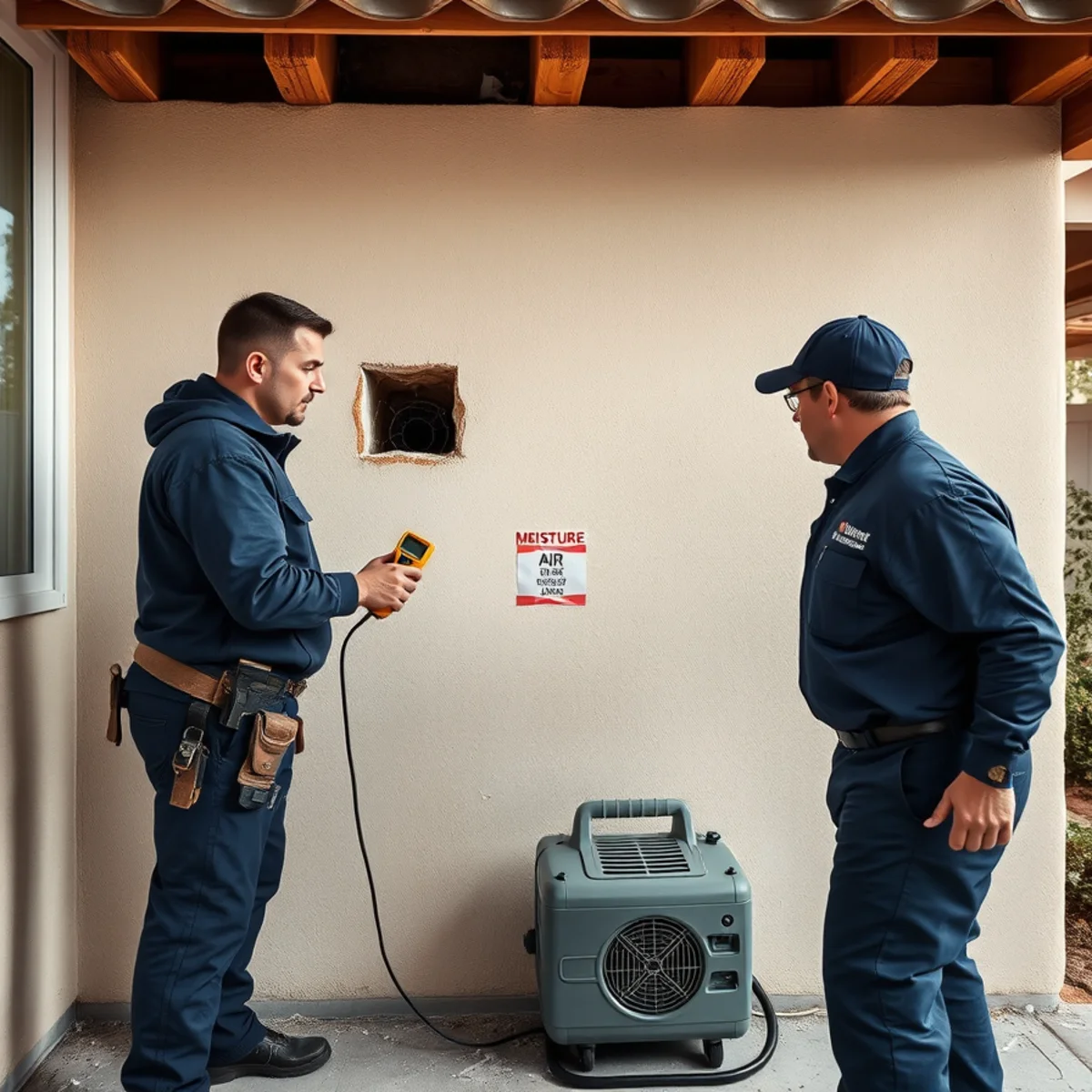
Pin and pinless moisture meters confirm what thermal suggests and, crucially, define the boundary of the wet area.
This distinguishes an active leak from an old dried stain, which matters more than people expect — plenty of homes have historic water marks from a repair done years ago, and chasing those wastes everyone's time.
It also maps the real footprint, which is what the eventual restoration scope is built from.
Step Four: Acoustic Listening
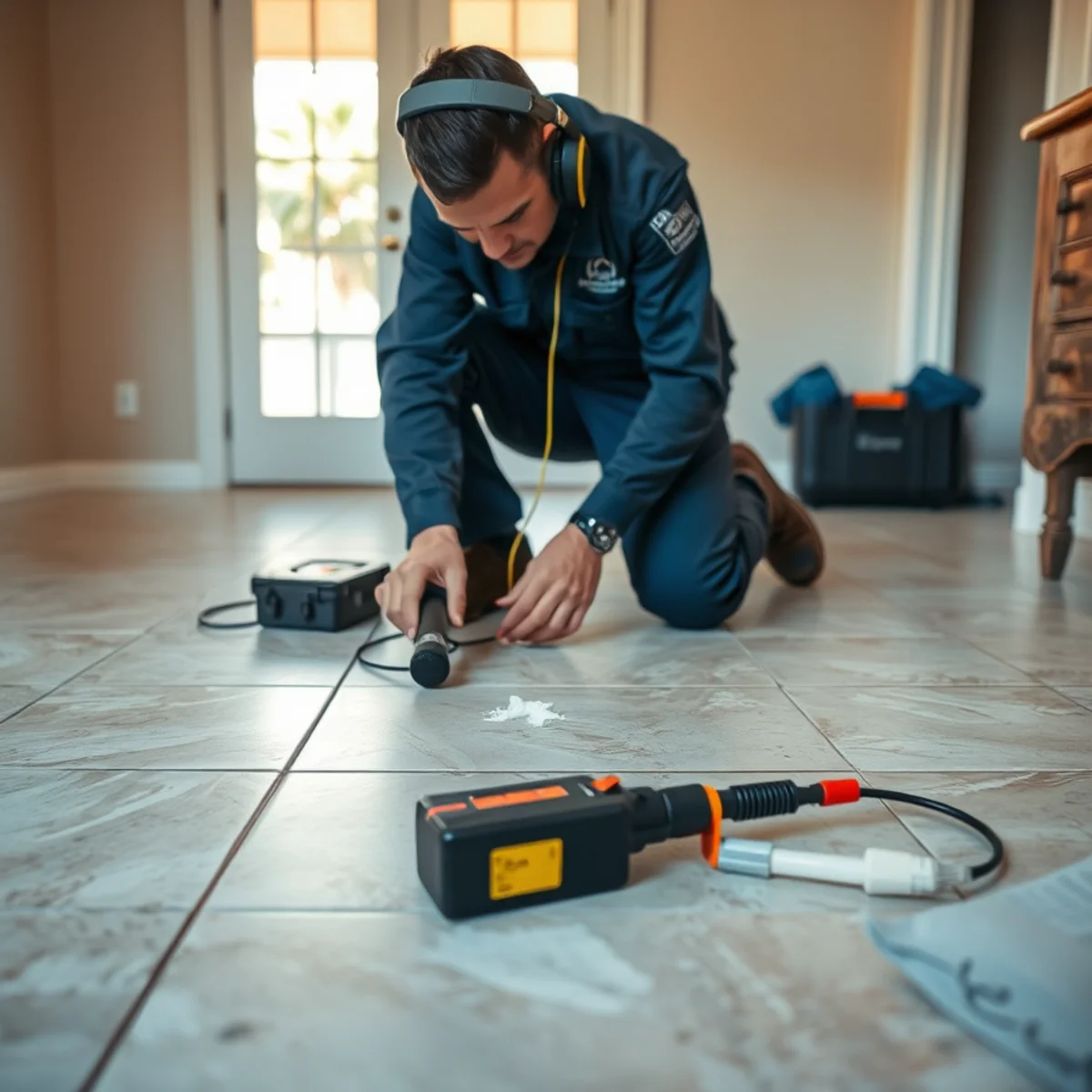
Water escaping a pressurized pipe makes a specific sound — a hiss at the escape point and a characteristic vibration transmitted along the pipe. Ground microphones and amplified listening discs pick that up through concrete.
This is frequently the technique that converts a general area into a precise point. The technician works across the suspected zone in a grid, listening for where the signal peaks.
It works best on higher-pressure systems and on smaller leaks, which is convenient because those are exactly the ones thermal struggles with. It is degraded by ambient noise, so a technician may ask you to shut off the HVAC and keep the house quiet.
Step Five: Tracer Gas, When Needed
For stubborn leaks — very small, or in a location where acoustics are ambiguous — the line is drained and charged with an inert hydrogen-nitrogen mix.
Hydrogen is the smallest molecule and it migrates up through concrete, flooring and grout to the surface, where a sensitive detector picks it up directly above the leak.
It is the most definitive method available and it is also the most involved, because the system has to be drained and recharged. It is usually reserved for cases the other three methods have not resolved.
What You Should Get at the End
A marked location on the floor, and a written report with thermal captures, moisture readings and photographs.
That report matters financially. Most California policies cover the cost of accessing the leak and the resulting water damage while excluding the pipe repair itself — and a documented detection report is what makes that access-and-damage portion of the claim clean.
Then, and only then, concrete gets opened at the marked point by a licensed plumber. One cut, one repair, one patch.
From the field
What you should get at the end, and what should worry you
A proper detection ends with a specific mark on the floor, a stated depth or run direction where determinable, photographs including thermal images, the moisture map, and a written report you can hand to a plumber. That report is what a plumber prices from and what an adjuster reads. If someone finishes a detection and cannot produce it, what actually happened is a guess narrowed by experience — which is sometimes right and is not what you paid for.
The sequence matters because each stage costs less than the next and rules out the most ground. Thermal imaging is fast and non-invasive but shows temperature differences, not water, so it produces false positives at ducts, radiant lines and sun-warmed slab. Acoustic listening is the pinpointing tool but it needs pressure in the line and a quiet house, which is why we ask for appliances off and why detections sometimes happen early in the morning.
The honest tradeoff: no method is perfect on every house. Post-tension slabs, deep pipe runs, thick flooring assemblies and ambient noise all degrade accuracy, and a good technician will tell you when confidence is moderate rather than high. In those cases opening a small, carefully chosen access point is more honest — and cheaper — than a wide exploratory cut based on a marginal reading.
Detection before demolition, always
Electronic location costs a fraction of exploratory concrete work, and it is what tells every subsequent quote what it is actually pricing.
Ask whether the report will be written
You need it for the plumber and for the claim. A verbal 'it's about here' does not travel between the three parties who need it.
Frequently Asked Questions
How accurate is slab leak detection?
With a full sequence — meter test, thermal imaging, moisture mapping and acoustic listening — a leak is typically located within a foot or two. Tracer gas, where it is needed, is more precise still. That is close enough that the plumber opens one small section of concrete rather than exploring.
How long does slab leak detection take?
Usually one to three hours for a typical single-family home, depending on size, flooring types and how quickly the leak reveals itself. Two-story homes with multiple bathrooms take longer, as do homes with heavy furniture or stored contents blocking access to floor areas.
Will insurance pay for leak detection?
Frequently yes. Most California policies cover the cost of accessing the leak and the resulting water damage while excluding the failed pipe itself — and a documented detection report with thermal captures and moisture readings is exactly what makes that portion of the claim straightforward.
Need help with this in Irvine?
We handle this work every week across Irvine and Orange County. A live dispatcher answers 24/7, gives you an arrival window, and tells you what to do while you wait. Free on-site assessment and written scope before any demolition.
Related services