Emergency Guides · 6 min read
Toilet Overflowing? How to Stop It — and When It's Actually a Sewage Emergency
A single overflowing toilet is a plumbing problem. Water coming up through a shower drain is a main line backup and a Category 3 health hazard. Here is how to tell them apart fast.
Short answer
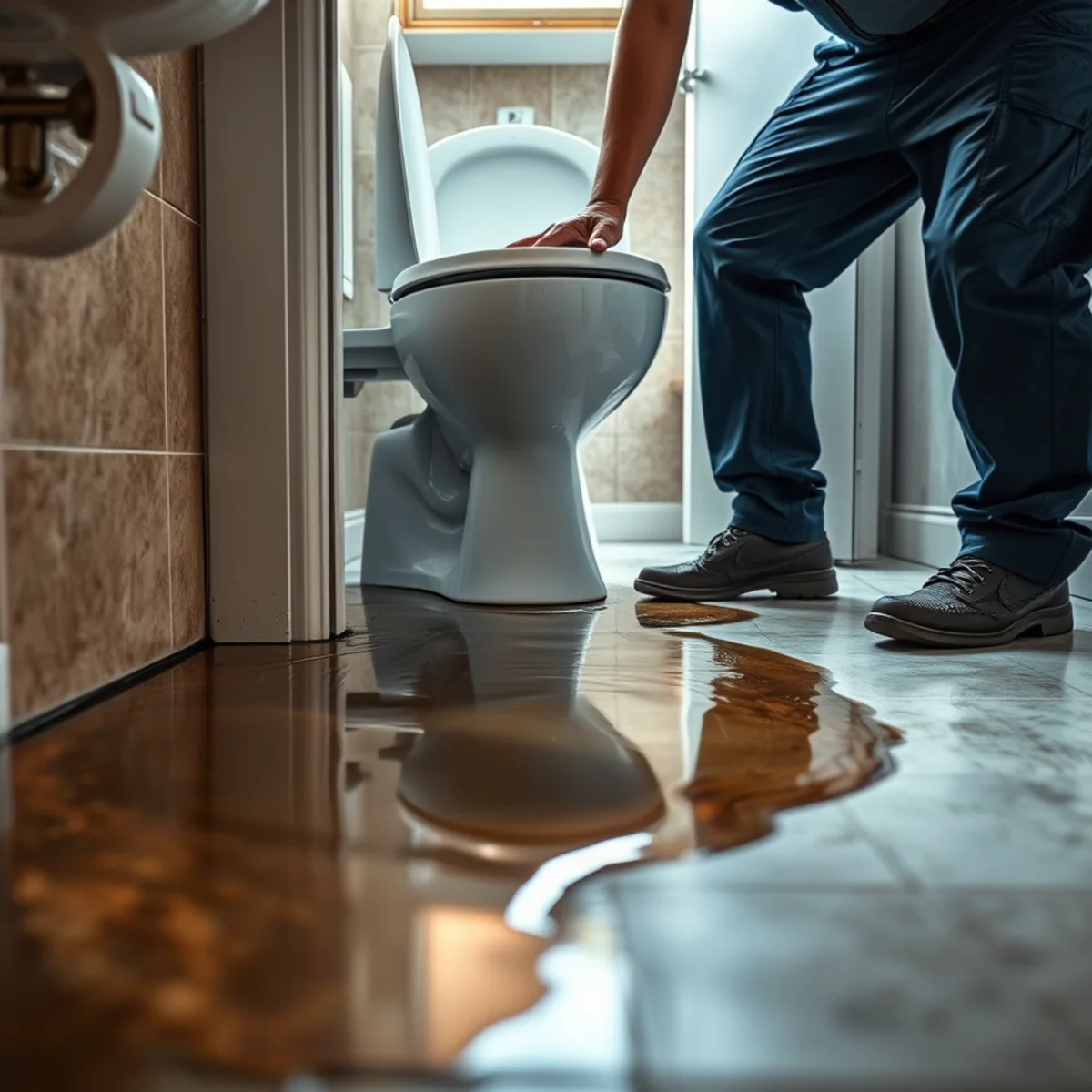
Close the angle stop behind the toilet — turn it clockwise until it stops. If it will not close, lift the tank lid and hold the float up. Then keep everyone off the wet area, stop using every other fixture in the house, and call for Category 3 cleanup. Sewage is a health problem, not a mopping problem.
The first thirty seconds decide how much of this you are cleaning up. There is a shut-off on the wall behind the toilet and there is a way to stop the flow inside the tank, and knowing both before you need them is genuinely useful.
The second thing to work out is whether this is a clogged toilet or something much more serious happening further down your drain system. Those two situations need completely different responses.
Stop the Water in Thirty Seconds
Two options, and do whichever is closer to your hand.
The angle stop is on the wall or floor behind the toilet where the supply line enters. Turn it clockwise until it stops. Be aware that angle stops which have never been turned frequently scale shut from hard water and will not budge — which is exactly why you should exercise them once a year.
If the valve will not turn, take the tank lid off and push the flapper down at the bottom of the tank with your hand. That seals the tank outlet and stops water leaving. Then lift the float arm or float cup to stop the fill valve.
Do not flush again. Every additional flush adds several more gallons to a bowl that already cannot drain.
Now Work Out What You Are Actually Dealing With
A single toilet that overflows and no other fixture misbehaving is almost always a local clog. Annoying, low risk, and a plunger or an auger usually resolves it.
Multiple fixtures behaving strangely is a different problem entirely. That points at the main line, and it means wastewater is backing up into the building rather than leaving it.
Water rising in a shower or tub drain
The lowest fixture in the house backs up first. If wastewater is surfacing in a ground-floor shower, the main line is blocked downstream.
The toilet bubbles when the washer drains
Air being pushed back through the trap. The system is restricted and finding another route.
Two or more fixtures backing up
One fixture is local. Two on different branches points at the main.
Gurgling drains, especially after heavy rain
Infiltration into an aging lateral. Common in older Orange County neighborhoods with clay pipe and mature street trees.
Sewer odor with no visible water
A dry trap, a cracked line under the slab, or a backup that already happened somewhere you cannot see.
Standing water right now? Call us before you do anything else.
We are on site within 60 minutes anywhere in Irvine, 24 hours a day.
If It Is a Main Line Backup, Stop Using Water Immediately
Every flush, every sink, every dishwasher cycle and every load of laundry adds volume to a line that already cannot carry it away. Until the blockage is cleared, the house goes on a full water hold — everyone, every fixture.
This is the single most common mistake we see. A family discovers a backup in one bathroom and carries on using the rest of the house, and by the time anyone calls a plumber the backup has reached three rooms.
Sewage Is a Health Problem, Not a Property Problem
Wastewater carries E. coli, salmonella, hepatitis A, giardia and a long list of other pathogens, and it aerosolizes — which means the contamination is not confined to the floor you can see it on. Under the IICRC S500 standard this is Category 3 water, and the handling requirements are not optional.
Keep everyone out of the affected area, including pets. Shut down the HVAC — running it pulls contaminated air through the return and distributes it to every room in the house.
Do not attempt to clean it with a mop and household bleach. Mopping aerosolizes pathogens into air you are breathing without a respirator and spreads contamination on the mop head. And bleach applied over organic soil is largely neutralized before it disinfects anything, so you get the smell of having cleaned without the result.
What Professional Sewage Cleanup Actually Involves
The area gets sealed in poly containment and put under negative air pressure so contaminated air cannot migrate to clean rooms. Technicians work in full PPE. Waste is extracted to a sealed holding tank.
Then porous materials that made contact come out and are disposed of — carpet, pad, drywall to a line above the contamination, insulation, and particleboard cabinet bases. Under S500 these cannot be reliably decontaminated, so this is not a judgment call.
Surfaces are cleaned first and disinfected second — that order matters, because disinfectant over soil does not work. Then the structure is dried while HEPA air scrubbers run continuously inside containment.
Finally, odor is addressed at the source. Sewage smell lives in the porous material that absorbed it, so removing that material removes the smell. Ozone or hydroxyl treatment is a finishing step, never a substitute.
Why Backups Happen Here
In older Orange County neighborhoods — Old Towne Orange, downtown Santa Ana, Old Town Tustin, parts of Costa Mesa and Fullerton — the most common cause is root intrusion into clay sewer laterals under mature street trees. Roots find the joints, grow into the line, and catch everything that passes.
In newer areas like most of Irvine, laterals are ABS or PVC that roots cannot penetrate the same way, so the causes shift: bellied lines from soil settlement, grease accumulation in multi-unit buildings, wipes and hygiene products, and shared laterals in attached condo communities where one unit's blockage backs up into whichever unit sits lowest.
On the wipes point: flushable wipes are not flushable. They are the single most common cause of residential main-line blockage we encounter, and the packaging is wrong.
From the field
What professional sewage cleanup actually involves, and why it costs more
The reason a sewage job is priced differently from a clean-water job is not the water. It is everything the protocol requires around it. Containment goes up first — poly barriers sealed to the floor and ceiling, with a negative air machine ducted outside so nothing aerosolised crosses into clean rooms. Technicians work in PPE. Every porous material the water touched comes out and is disposed of as regulated waste: carpet, pad, laminate, drywall to a flood cut above the wick line, and insulation in any wall that was wetted.
What stays gets cleaned and then treated with an antimicrobial, and only then does drying start. The step people are surprised by is that the drying phase is essentially the same as a clean-water job — the extra cost sits almost entirely in the removal, the containment and the disposal.
The tradeoff worth being honest about: a small, freshly overflowed toilet on a tiled bathroom floor, caught within minutes, genuinely can be handled by a homeowner with disinfectant and care. What cannot be is water that reached carpet, crossed a threshold into a room with porous flooring, or came up as a main line backup carrying waste from the rest of the house. The difference is contamination in materials you cannot see into.
Stop using every fixture in the house
If it is a main line backup, running a sink or a washing machine anywhere sends more water to the same blocked line and back up through the lowest fixture.
Do not use a household shop vac
It aerosolises contaminated water through an unfiltered exhaust and contaminates the machine. Extraction on Category 3 uses equipment that gets decontaminated afterwards.
Frequently Asked Questions
Is my insurance going to cover a sewage backup?
Only if your policy includes a water backup of sewers or drains endorsement. It is not part of standard California homeowners coverage. Most carriers offer it for a modest annual premium with a coverage cap of $5,000 to $25,000. Check your declarations page now — it cannot be added retroactively.
Can I clean up a small toilet overflow myself?
If it is clean water from the tank on a hard-surface floor, yes. If there is any waste involved, or it reached carpet, drywall or cabinetry, get it handled professionally. Even a small backup carries pathogens that aerosolize during cleaning, and household bleach over organic soil does very little.
How do I know if the blockage is in my line or the city's?
Generally, if the blockage is between your house and the property line it is yours; beyond that it is typically the city's or the district's. A plumber's camera inspection will locate it. If multiple homes on your street are backing up at once, call the city before you call a plumber.
Need help with this in Irvine?
We handle this work every week across Irvine and Orange County. A live dispatcher answers 24/7, gives you an arrival window, and tells you what to do while you wait. Free on-site assessment and written scope before any demolition.
Related services